How to Stop Overthinking at Night: Why It Gets Worse After Dark
Counting, arguing and thinking harder keep you awake. How to stop overthinking at night by meeting what's behind the heavy thought, right there in bed.


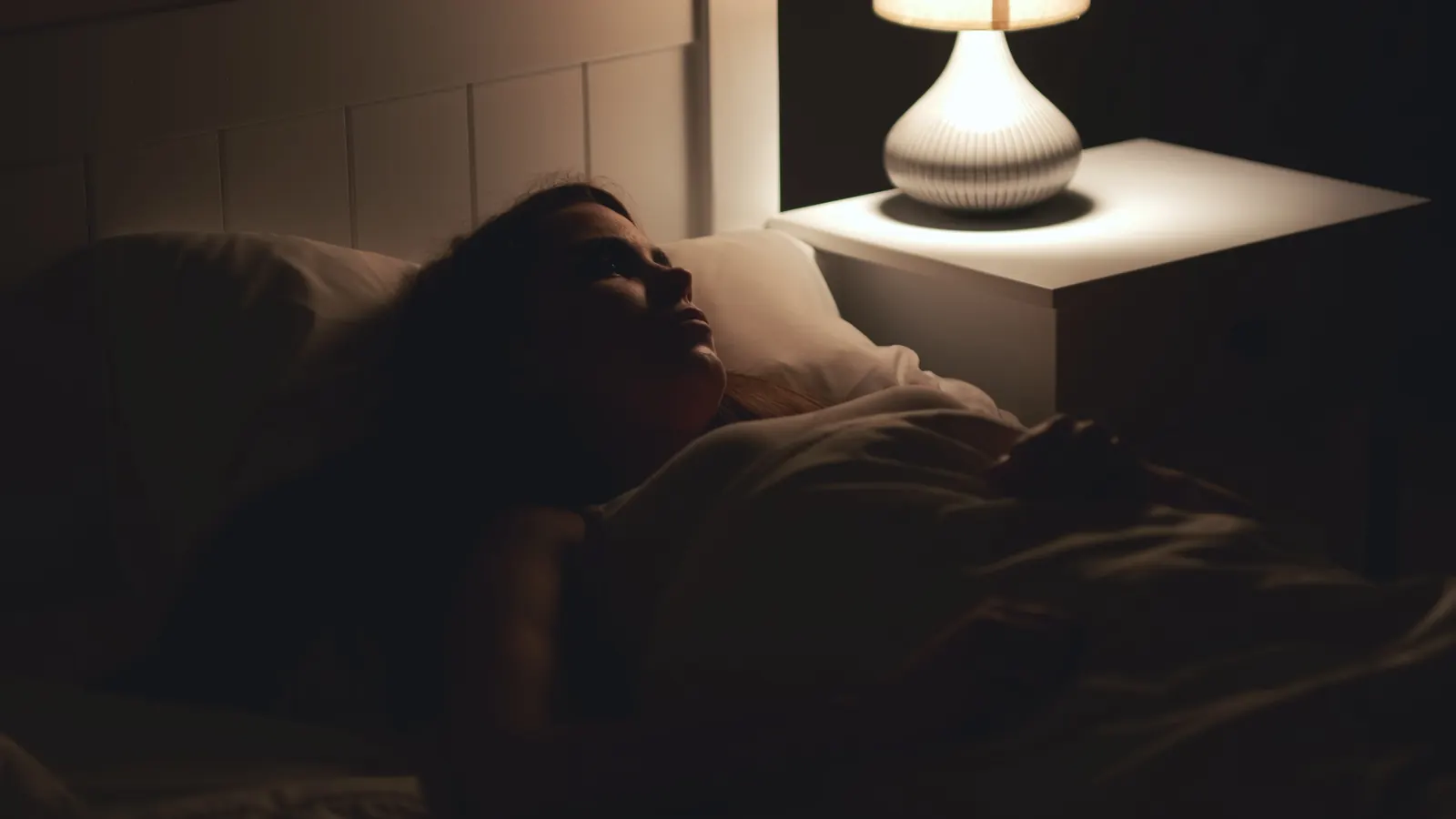
It’s 1:40 a.m. You’re replaying what you said in the meeting. You’re rehearsing tomorrow’s difficult conversation, three different versions. Then the bill, the test results, your son who didn’t call back.
Your body is lying safely in a warm bed. Your mind is building a nightmare about next year.
You’ve tried the tricks. Counting backwards. The breathing app. The worry list on the nightstand. Some nights they help. Other nights the thoughts just wait politely for you to finish, and start again.
Maybe the thoughts aren’t the problem you need to solve. They’re the noise on top of something you can feel. And feeling it is much quieter than fighting it.
Why does overthinking get worse at night?
During the day you have a hundred ways not to feel. Work, errands, the phone, other people’s voices. At night they’re all gone. It’s you, the dark and the ceiling.
And something else happens when you lie down and stop moving. When the body is still, the feelings that movement usually covers begin to rise. We use exactly that in our sessions, on purpose. At night it happens to you by accident, with nobody there to tell you what to do with it.
So the pressure in your chest comes up. The mind feels it and rushes to explain it, to find who caused it, to plan how to make it stop. That’s the overthinking. The mind isn’t attacking you. It’s trying to solve a feeling with thoughts, and that can’t be done.
Can’t sleep, overthinking: why fighting the thoughts doesn’t work
We sometimes call the mind the dragon, because it is loud, it breathes fire, and it guards its cave very well. Its job is to keep you away from what you feel. It explains, it worries, it compares, it plans, it rehearses tomorrow’s argument.
You don’t need to silence the mind. You can’t. Nobody can, and trying is just one more way of fighting. That’s why trying to “quiet the mind” can turn into one more thing to fail at, at two in the morning.
Here is the most practical sentence we know, and it took us years to see it: “Either you think and you don’t feel, or you feel and you have no time to think. There is no middle.”
When your attention is fully in the body, on the place that presses, the dragon goes quiet by itself. Not because you defeated it. Because you stopped feeding it.
Racing thoughts at night: what’s underneath them
Fear lives in the future. The feeling lives now. Notice where your racing thoughts are: tomorrow, next year, what if. The feeling that drives them is here, in the bed, right now.
One question helps you step out of the loop: do I know this one hundred percent, right now? Will he leave, are the test results bad, will the money last? You don’t know, and nobody does at two in the morning. The thought only pretends to know.
Then go to where you feel it. The mind’s voice comes with pressure: hurry, decide now, you will lose everything. The heart’s voice has time.
If you wake in the small hours with your heart pounding, we wrote about that night in waking up at 3am with anxiety. If the loops are mostly about what’s coming, read how to deal with fear of the future. And if what fills the dark is loneliness, how to stop feeling lonely at night is for you.
The whole method is in The Feeling Session. But you can start tonight with five minutes, right where you are. You’re already lying down. That’s half of it.
Practice5 min
A five-minute Feeling Session in bed
- Lie on your back. Turn the phone face down, or put it in another room.
- Cover your eyes with a sleep mask or a folded T-shirt. Let the room go dark.
- Arms by your sides, palms down. Nothing to grab.
- Close your mouth and leave the breath alone. No counting, no technique.
- Stop moving. No turning over, no checking the clock.
- Ask one question: where is it heaviest in my body right now? The chest, the belly, the throat, the jaw. Take the strongest place.
- Put all of your attention there, and keep it there. You’re not trying to make it go away so you can sleep. You’re simply with it.
- The thoughts will come. Let them pass like cars on a street. The moment you notice you’re in a story, come back to the place. No blame.
- If it gets stronger, stay one more minute if you can. Stop whenever you need to.
What you might notice: your thoughts may get quieter while your attention is on the body. The pressure may grow before it shifts. Or you may notice nothing much the first night. Every one of those is allowed.
The day Rytis heard the voice
The dragon is so convincing because it speaks in your own voice. It uses your words: I, me, my. “I can’t do this.” “I’m such an idiot.” “I really want…”
One of the biggest moments in Rytis’s life was the day he heard it clearly for the first time: a sentence starting with “I really want,” spoken in his own voice inside his head. And he realized it was not him speaking.
That voice at 2 a.m. sounds like you. It isn’t you. You’re the one who hears it.
Night is when the thoughts are loudest, and that’s why Lighter happens in the evening: seven evenings lying down with your eyes covered, in our own words and Violeta’s voice. The last of them is about exactly this, the mind that won’t stop.
Before you turn the light off
- Phone out of reach. Before you lie down, turn it face down or put it in another room.
- Ten seconds in the day. Several times today, stop with your eyes closed and notice what your body is holding. The feelings you never give room in the day are the ones waiting for you at night.
- Ask the one-hundred-percent question. When a loop starts, ask: do I know this one hundred percent, right now? Then go back to the body.
- No decisions after midnight. Don’t send the message, don’t write the resignation. We say it in every session: “First the feeling, then the decision. Answers come from calm, never from the middle of a wave.”
- If it’s been weeks of bad nights, talk to your doctor as well. Long sleeplessness deserves care, alongside this.
Overthinking is one of the states we write about, the ones that tend to come back night after night.
A dog barks at the fence every time a cat runs past. That’s what dogs do. You don’t argue with it, and you don’t hand it the keys to the house. You let it bark, and you keep your attention where you are: in your own body, in your own bed.